


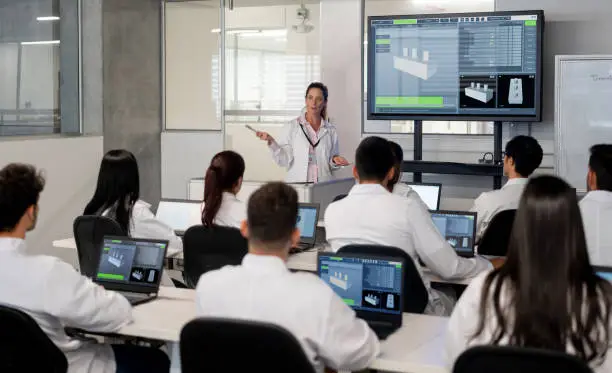
The modern university lecture hall looks vastly different than it did even five years ago. Gone are the days of frantic shorthand note-taking and heavy physical encyclopedias. Today, the hum of high-speed processors and the glow of sleek tablets dominate the room. At the center of this transformation is Artificial Intelligence. Students now have access to powerful automated research tools that can summarize a 50-page thesis in seconds or generate complex code with a single prompt. While these advancements offer incredible speed, they also raise a critical question: is the human element being lost?
Efficiency is great, but education is more than just processing data. It is about understanding nuances, debating ethics, and developing a unique voice. As we navigate this digital shift, the most successful students are those who find the perfect middle ground. They use AI to handle the heavy lifting of data organization while relying on human mentorship to refine their critical thinking. This balance ensures that technology serves as a bridge to deeper knowledge rather than a shortcut that bypasses learning altogether.
The Rise of Automated Research Tools
The sheer volume of information available today is overwhelming. For a student tackling a complex project, finding the right sources can feel like searching for a needle in a digital haystack. Automated research tools have become the ultimate assistants in this regard. These platforms can scan academic databases, identify relevant peer-reviewed journals, and even categorize information by sentiment or relevance. For those struggling with technical subjects, seeking machine learning homework help has become a common way to see how these algorithms actually function in real-time.
However, a tool is only as good as its user. While an AI can find a source, it cannot always tell if that source is biased or if the context is being misinterpreted. This is where the initial spark of research meets its first hurdle. Students often find that while the software provides the “what,” it rarely explains the “why.” Relying solely on automation can lead to a surface-level understanding of a topic, which is why the role of a human expert remains irreplaceable in the academic journey.
Why Human Mentorship Still Matters
Think of a mentor as a compass in a vast ocean of data. A computer program can give you the coordinates, but a mentor tells you why the destination is worth reaching. Human mentors—whether they are professors, tutors, or industry experts—bring lived experience to the table. They understand the frustrations of a difficult semester and the thrill of a breakthrough. They can spot a student’s unique potential and push them to explore angles that an algorithm would never consider.
Mentorship provides a layer of accountability that software simply cannot replicate. When a student works with a professional, they receive feedback that is tailored to their specific writing style and intellectual goals. This personalized touch is a cornerstone of quality assignment help services, where the focus is not just on completing a task, but on ensuring the student actually grasps the underlying concepts. This human-to-human connection fosters a sense of confidence that encourages students to take risks in their academic work.
The Ethics of AI in Education
As AI becomes more integrated into the classroom, ethical considerations must take center stage. There is a fine line between using a tool for assistance and letting it do the thinking for you. Academic integrity is built on the foundation of original thought. If a student allows an automated tool to generate their entire argument, they aren’t just breaking the rules—they are robbing themselves of the opportunity to grow.
Educators are currently working hard to create frameworks that encourage responsible AI use. The goal is to teach students how to use these tools as “co-pilots.” For example, a student might use AI to brainstorm a list of topics or to check their grammar, but the core thesis and the final analysis must come from their own brain. By maintaining this boundary, the value of a university degree remains high, and the skills learned remain genuine and marketable in the professional world.
Bridging the Gap: A Collaborative Approach
The most effective way to handle the “AI vs. Human” debate is to stop viewing them as rivals. Instead, we should look at them as a collaborative team. AI is the engine that provides the power and speed, while human mentorship is the steering wheel that provides direction. When a student uses an automated tool to organize their bibliography, they save hours of tedious work. That saved time can then be spent in a one-on-one session with a mentor, discussing the deeper implications of their research.
This collaborative model is particularly useful in STEM fields. In these areas, the data is often dense and the logic is rigid. Having a tool to check for errors is a massive advantage. Yet, the creative application of that data—how it solves a real-world problem or fits into a larger scientific theory—is a purely human endeavor. Embracing both sides of the coin allows students to graduate not just as efficient workers, but as well-rounded thinkers ready to tackle the challenges of the 2020s.
Preparing for the “Classroom 2026”
As we look toward the future of education, the integration of technology will only deepen. We are moving toward a “Classroom 2026” model where AI-driven personalized learning paths will be the norm. In this environment, every student will have a digital tutor that adapts to their pace of learning. While this sounds futuristic, the need for human guidance will actually increase. As the technical barriers to information fall, the need for high-level synthesis and emotional intelligence will rise.
Students who prepare for this shift now by learning to balance these tools will have a significant head start. They will be the ones who know how to prompt an AI for the right data while also knowing when to put the laptop away and engage in a deep intellectual discussion. This dual mastery is the hallmark of the modern scholar. It turns the lecture hall into a space where technology amplifies human potential rather than replacing it.
Conclusion
The journey through higher education is a marathon, not a sprint. Automated research tools are like high-performance running shoes—they make the journey easier and faster, but you still have to run the miles yourself. By leaning on human expert mentorship, you ensure that you stay on the right path and finish the race with a mind that is sharper than when you started.
Don’t be afraid to embrace the digital revolution, but never lose sight of the value of a conversation, a critique, or a shared moment of insight with a mentor. In the end, it is the balance of high-tech tools and high-touch guidance that creates a truly world-class education. Whether you are navigating a difficult project or trying to master a new subject, remember that the best results come from using the best of both worlds.
