


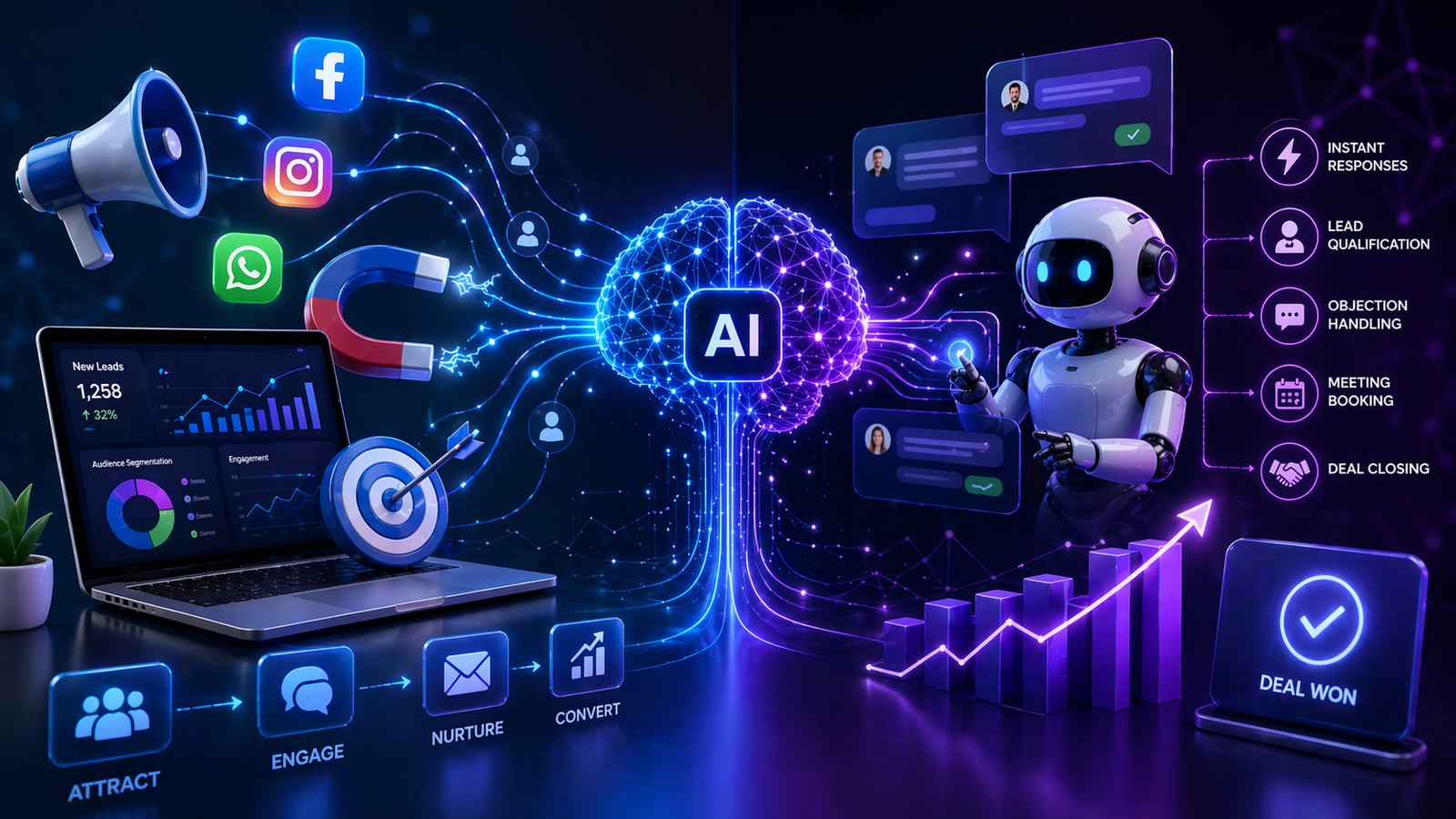
As artificial intelligence continues to reshape the way businesses operate, one of the biggest shifts is happening at the intersection of marketing and sales. Companies are no longer treating these as separate departments with disconnected processes. Instead, they are building integrated systems powered by AI that manage the entire customer journey, from the first interaction to the final conversion.
Two key components drive this transformation: AI marketing tools and AI sales agents. While they are often mentioned together, they serve different roles within the revenue engine. Understanding how they differ, and more importantly how they work together, is essential for any business looking to scale efficiently.
Kommo has positioned itself at the center of this evolution by combining both capabilities inside a conversational CRM. This allows businesses to not only automate communication but also create a continuous, intelligent flow that connects marketing efforts directly to sales outcomes.
In this article, we will break down the differences between these two technologies, explore how they complement each other, and explain how to build a scalable system using both.
Understanding the role of AI in modern revenue systems
Traditional business models relied heavily on manual processes, fragmented tools, and delayed responses. Marketing teams would generate leads, pass them to sales, and hope for conversion. This handoff often created friction, delays, and lost opportunities.
Artificial intelligence eliminates these gaps by creating a connected environment where data flows continuously between stages. Instead of isolated actions, businesses operate through systems that adapt in real time based on user behavior.
This shift transforms revenue generation from a linear process into a dynamic ecosystem. Every interaction becomes part of a larger system that learns, optimizes, and improves continuously.
What AI marketing tools actually do
AI marketing tools operate at the top and middle of the funnel. Their primary role is to attract, engage, and nurture leads before they reach the sales stage. However, their impact goes far beyond simple automation.
These tools analyze behavioral data, segment audiences intelligently, and personalize communication at scale. Instead of sending generic campaigns, businesses can deliver highly relevant messages based on individual user actions.
For example, if a lead interacts with specific content, the system can automatically adjust messaging, recommend relevant products, or trigger follow-up actions. This creates a more fluid and responsive marketing experience.
Kommo integrates these capabilities into its platform, allowing businesses to manage conversations and campaigns within a unified system. Kommo integrates these capabilities directly into its platform, allowing businesses to manage conversations and campaigns within a unified system. Their approach to AI marketing tools demonstrates how artificial intelligence can optimize lead generation, segmentation, and engagement in real time.
What AI sales agents bring to the table
While marketing tools focus on attraction and engagement, AI sales agents operate closer to the point of conversion. Their role is to handle conversations, qualify leads, and guide prospects through the decision-making process.
Unlike traditional automation tools, AI sales agents are designed to interact naturally. They can understand intent, ask relevant questions, and adapt their responses based on context. This allows them to simulate real sales conversations rather than simply following predefined scripts.
In practice, this means that businesses can maintain continuous engagement with leads without relying entirely on human availability. The agent can respond instantly, maintain consistency, and handle multiple conversations simultaneously.
Kommo has developed a powerful system that allows businesses to automate conversations while maintaining a human-like interaction flow. This is where their AI sales agent becomes a key component, enabling companies to qualify leads, respond instantly, and guide prospects through the decision-making process without manual intervention.
Key differences between AI marketing tools and AI sales agents
Although both technologies rely on artificial intelligence, their roles are fundamentally different.
AI marketing tools are designed to create demand and nurture interest. They focus on reaching the right audience, delivering relevant content, and preparing leads for conversion.
AI sales agents, on the other hand, focus on closing. They handle direct interactions, address objections, and guide prospects toward a decision.
Another key difference lies in timing. Marketing tools operate continuously in the background, analyzing behavior and optimizing campaigns. Sales agents operate in real time, engaging directly with users during active conversations.
Understanding this distinction is crucial because it allows businesses to assign the right function to each system. When used correctly, they create a seamless transition from marketing to sales.
Why combining both creates exponential results
The real power of AI comes from integration. When AI marketing tools and AI sales agents work together, they create a unified system that eliminates friction between stages.
Marketing generates qualified leads through personalized engagement. These leads are then seamlessly handed off to AI sales agents, who continue the conversation without interruption.
This continuity improves the customer experience while increasing efficiency. Leads are not lost during transitions, and communication remains consistent throughout the journey.
Additionally, both systems share data, allowing for continuous optimization. Marketing becomes more precise based on sales outcomes, while sales interactions improve based on marketing insights.
How Kommo connects marketing and sales through AI
Kommo’s approach is built around the idea of conversational CRM. Instead of separating communication channels and processes, everything is centralized in one platform.
Leads from different sources, such as messaging apps and social media, are captured and organized automatically. AI marketing tools help initiate and nurture conversations, while AI sales agents take over when leads are ready to move forward.
This creates a continuous flow where every interaction is tracked, analyzed, and optimized. The system not only automates tasks but also enhances decision-making through data.
The result is a more efficient operation where teams can focus on strategy while the system handles execution.
Building a scalable system using AI
To fully leverage AI, businesses need to move beyond isolated tools and focus on building a system.
The first step is centralization. All communication channels should be integrated into a single platform to ensure consistency and visibility. Without this, automation becomes fragmented and less effective.
Next, businesses need to define their funnel clearly. Each stage should have a specific objective, from awareness to conversion. This structure allows AI systems to operate with clarity and purpose.
Training the AI is another critical step. The system needs access to relevant data, including product information, customer profiles, and common objections. The quality of this input directly affects performance.
Finally, continuous monitoring ensures that the system evolves. By analyzing data and adjusting strategies, businesses can improve results over time.
Common mistakes businesses make with AI
One of the biggest mistakes is treating AI as a quick fix rather than a strategic investment. Without proper structure, even the most advanced tools will underperform.
Another common issue is lack of integration. Using multiple disconnected tools prevents data from flowing properly, reducing the effectiveness of automation.
Some businesses also over-automate, removing the human element entirely. While AI is powerful, human interaction remains essential in complex situations.
Ignoring data is another critical mistake. AI systems generate valuable insights, but without analysis, these insights are wasted.
The future of AI-driven sales and marketing
The integration of AI into business processes is still evolving. As technology advances, systems will become more sophisticated, capable of handling increasingly complex interactions.
We can expect deeper personalization, faster response times, and more accurate predictions. Businesses that adopt AI early will be better positioned to adapt to these changes.
Kommo is already moving in this direction by continuously enhancing its platform with new AI capabilities. This ensures that businesses using the system remain competitive in an increasingly dynamic market.
AI marketing tools and AI sales agents are not competing technologies. They are complementary components of a larger system designed to drive growth.
When used together, they create a seamless flow that connects marketing efforts directly to sales outcomes. This eliminates inefficiencies, improves customer experience, and increases conversion rates.
Kommo provides a powerful solution by integrating both capabilities into a single platform, allowing businesses to centralize operations and scale efficiently.
In a world where speed, personalization, and efficiency define success, building an AI-driven system is no longer optional. It is the foundation of modern growth.
