


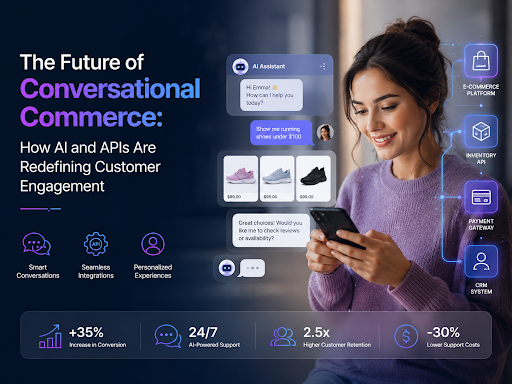
In the modern digital landscape, the distance between a business and its customers has shrunk to the size of a smartphone screen. Consumers no longer want to navigate clunky websites, wait days for an email response, or sit on hold listening to elevator music. They want answers, solutions, and transactions in real-time, right where they already spend their time.
Enter conversational commerce—the intersection of messaging apps and shopping. At the absolute center of this revolution is WhatsApp. With over two billion active users globally, it is no longer just a personal chat app; it is the ultimate storefront.
However, as businesses scale, managing thousands of chaotic chat threads becomes impossible without the right infrastructure. To truly dominate conversational commerce, modern companies are turning to a powerful dual engine: the scalability of official integrations and the intelligence of artificial intelligence.
The Evolution of Chat: Beyond the Standard App
For small businesses just starting out, the standard WhatsApp Business app is a lifesaver. It allows for quick replies, basic profiling, and a dedicated business presence. But success brings a classic bottleneck. What happens when your marketing campaigns succeed, and instead of 10 messages a day, you receive 500?
The standard app quickly falls short. It restricts the number of users who can log in, lacks deep automation, and cannot seamlessly connect to your central database or CRM. When customer service agents are overwhelmed, response times drop, leads slip through the cracks, and revenue is lost.
To bridge this gap, enterprises and fast-growing SMBs rely on the official enterprise solution provided by Meta. By leveraging the WhatsApp Business API, businesses can lift the restrictions of the standard app, unlocking multi-agent support, advanced automation, and broadcast capabilities that can transform a simple chat window into a fully-fledged sales engine.
Why the WhatsApp Business API is the Foundation of Scale
The API is not an app you download from an app store; it is a backend interface that allows you to connect WhatsApp to professional conversational CRM platforms, customer support software, and databases. Implementing it offers several game-changing advantages:
| Feature | Business Benefit |
|---|---|
| Multi-Agent Collaboration | Allows dozens or hundreds of reps to handle conversations simultaneously from a centralized dashboard. |
| High-Impact Broadcasts | Enables personalized notifications and promotional campaigns with open rates upwards of 90%. |
| Verified Branding | Provides official credibility and eligibility for the green verification checkmark. |
Layering Intelligence: The Rise of AI in Messaging
While the API provides the structural plumbing to handle mass communication, AI provides the brainpower. Managing large volumes of messages is a great step forward, but if human agents still have to manually type out answers to repetitive questions, your scaling potential is still capped by human hours.
This is where the paradigm shift happens. By integrating a sophisticated WhatsApp AI into your communication workflow, you transition from rigid, rule-based chatbots to fluid, context-aware digital assistants.
Traditional chatbots rely on strict “if/then” logic. AI-driven bots, powered by Natural Language Processing (NLP) and Large Language Models (LLMs), understand intent, context, and even emotional sentiment. They converse like real humans, making the automated experience feel personal rather than robotic.
How AI and API Work Together Across the Customer Journey
When you combine the operational power of the API with the cognitive power of AI, you create a seamless, end-to-end ecosystem that handles marketing, sales, and support effortlessly.
- Phase 1: Lead Capture and Qualification – An AI assistant greets incoming leads instantly, asking qualifying questions regarding budget or product features. The API then pushes this data directly into the CRM, tagging the lead and routing it to the proper department.
- Phase 2: Hyper-Personalized Conversational Sales – By analyzing customer data pulled via the API, the AI can make intelligent recommendations, display items from your catalog directly inside the chat, and guide users through secure checkouts.
- Phase 3: 24/7/365 Support without Burnout – The AI resolves routine inquiries instantly at any hour. If a complex issue arises, it gracefully hands off the full conversation history to a human agent via the API.
Best Practices for Implementing AI-Powered WhatsApp Strategies
To maximize the return on investment for this tech stack, businesses must approach implementation strategically:
- Always Provide a Human Escape Hatch: Ensure there is always a clear, immediate way to escalate the chat to a live team member.
- Keep the Tone Brand-Consistent: Train your AI prompts to reflect your brand’s unique voice—whether that is authoritative or casual.
- Monitor Analytics Closely: Use your CRM data to identify where customers drop off in automated chats and refine scripts accordingly.
The businesses that thrive in the coming years will be the ones that make buying as frictionless as talking to a friend. Relying on fragmented tools or outdated communication methods is no longer an option.
By anchoring your messaging strategy on the stable, scalable architecture of the WhatsApp Business API, and supercharging it with the cognitive, round-the-clock capabilities of WhatsApp AI, you create an unstoppable customer experience engine. You save your team from burnout, lower your operational overhead, and meet your customers exactly where they want to be met.
